Kaley Ubellacker

Happenings at Necessary Ventures:
Arc raised $50 million in a Series C round from Eclipse, a16z, Menlo Ventures, Lowercarbon Capital, Offline Ventures, and your very own Necessary Ventures. With this funding, Arc is expanding into defense tech, planning to sell electric propulsion systems to defense contractors. More from Bloomberg.
For the rushed reader …
An interesting new paper published by the National Bureau of Economic Research documents how AI research has dramatically shifted from academia to industry over the past two decades.
SPACs are making a strong comeback, now targeting deep-tech companies with a focus on quantum computing.
A new wave of fusion startups is racing to develop commercially viable reactors, with a collective $10 billion raised.
Good Reads 📖

Data migration
The AI talent pool is graduating straight from universities to corporate labs. An interesting new paper published by the National Bureau of Economic Research documents how AI research has dramatically shifted from academia to industry over the past two decades. Using a dataset linking publication records to U.S. Census employment data, the authors track 42,000 AI researchers and show that top industry salaries have quintupled since 2001. The shift inevitably drives early-career talent toward compute-rich incumbents like Google, Meta, and Microsoft. Meanwhile, university salaries stagnated or declined. As researchers move into industry, their output shifts sharply: academic publishing dropped by roughly 63% while patents increased sixfold, signaling a move from open science toward proprietary, commercially focused innovation. Additionally, female representation has grown more in academia than in industry, and pay gaps remain substantial. The study paints a picture of a frontier innovation ecosystem increasingly shaped by corporate resources and commercial incentives. Classrooms are out; the cloud is in.
Check, please
It's SPAC to the future for startups. SPACs are making a strong comeback, now targeting deep-tech companies with a focus on quantum computing. After their rise and collapse in 2021, SPACs are returning as a faster, more capital-certain path to public markets, allowing startups like IQM, Pasqal, Infleqtion, and Xanadu to raise hundreds of millions of dollars quickly without traditional IPO requirements. The surge in SPAC activity is fueled by high public-market appetite, partly driven by AI-related compute bottlenecks and recent advances moving quantum machines from the lab toward practical applications. Venture capital funding for quantum has more than tripled recently, but private money alone isn’t sufficient to commercialize the hardware. SPACs are also drawing attention in other deep-tech areas, like nuclear fusion and space ventures. Startups are jumping into public markets faster than you can say “double-slit dilemma.”
Hot stuff
Here’s your cue to stay in touch with current events. A new wave of fusion startups is racing to develop commercially viable reactors, with a collective $10 billion raised. Most people couldn’t tell you what fusion actually is. At its core, fusion generates electricity by fusing atoms, and startups are experimenting with two main approaches: magnetic confinement and inertial confinement. Magnetic confinement uses powerful superconducting magnets to contain superheated plasma in tokamaks or stellarators, and inertial confinement compresses fuel pellets using lasers, pistons, or electromagnetic pulses. Notable players include Commonwealth Fusion Systems, Tokamak Energy, and several European stellarator-focused startups. Laser-driven inertial confinement has already reached scientific breakeven in lab settings. With demonstration devices like CFS’s Sparc expected to turn on in 2026 and commercial-scale plants planned soon after, the industry is moving rapidly. There’s no doubt fusion startups are headed for a bright future.
Market Stirrings 🚩
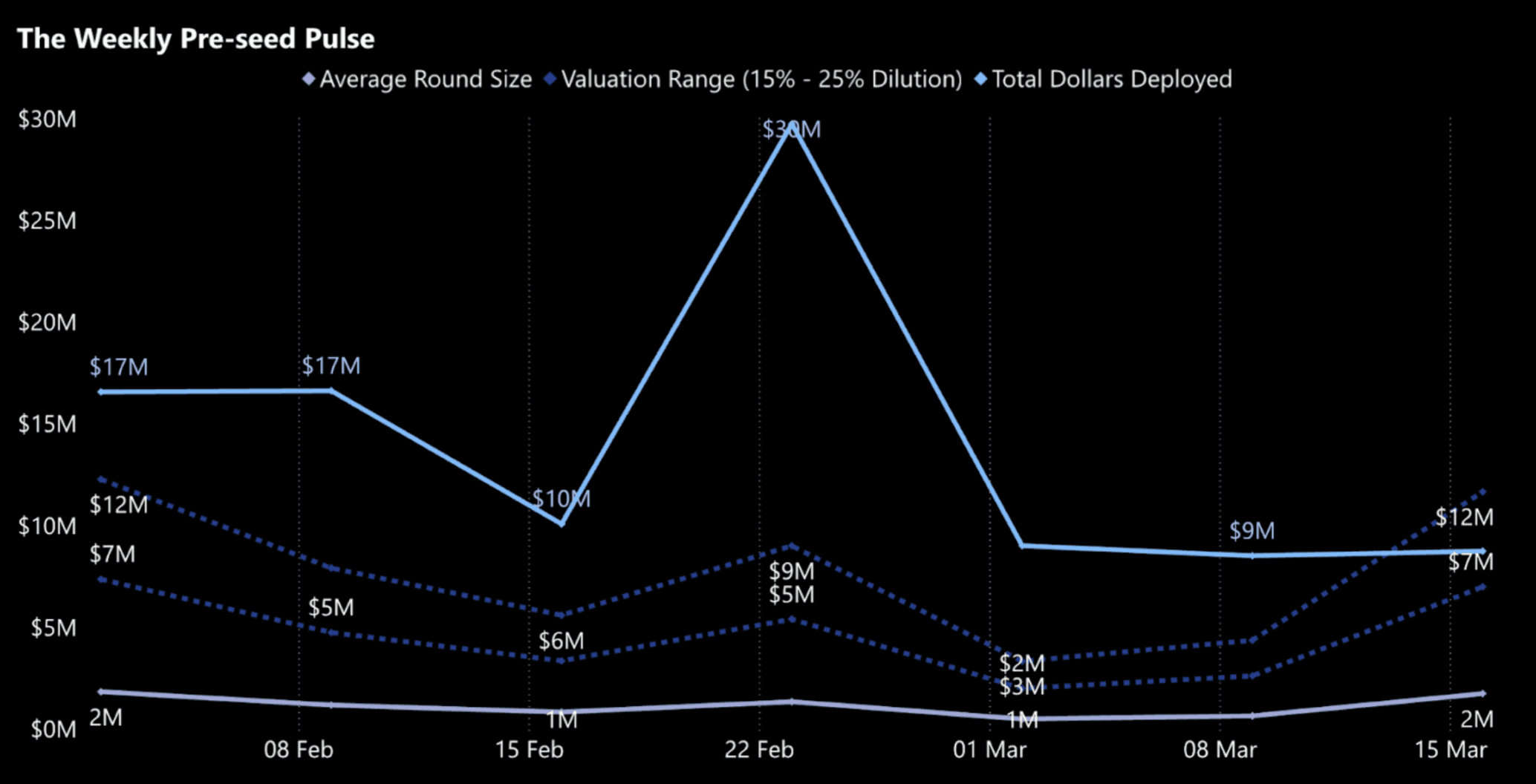
Here's what the week looked like in pre-seed:
$8.8M
7
Data aggregated from proprietary research and Crunchbase; valuation estimate based on 10-20% ownership stake.
Receive our original research and thinking right to your inbox before we share it with the rest of the world:
SEED IT TO BELIEVE IT
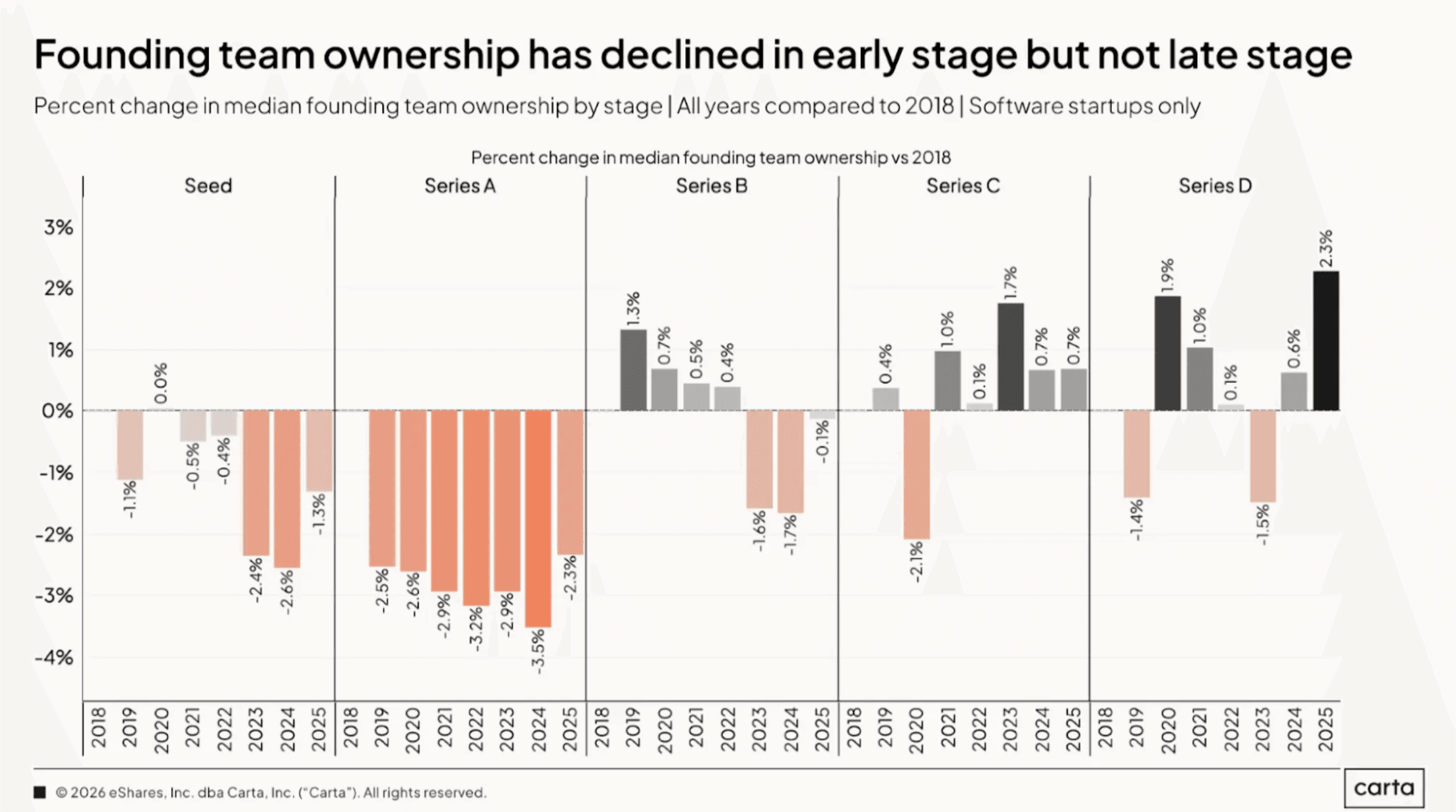
Founding team ownership is split: early-stage founders are facing an equity squeeze while late-stage founders see gains compared to 2018. Seed and Series A ownership hit a low in 2024, down as much as 3.5%. Last year, Series D ownership increased to 2.3% compared to 2018, perhaps pointing to a survivor's premium.
healthtech
Dentronic - Filling the gap.
Dentronic raised $1 million from Crew Capital and South Park Commons. Dentronic is building AI-powered robotic assistants that automate repetitive tasks during dental procedures.
AI
VoiceBit - Order up, profit up.
VoiceBit raised $2.5 million led by 1984 Ventures. VoiceBit is developing an AI infrastructure layer that enables restaurants to automate their ordering channels.
AI
Certiv - Under serv-AI-llance.
Certiv raised $4.2 million led by Aviso Ventures. Certiv is building endpoint security software that monitors AI agents on employee devices.
JOB OPPORTUNITIES
| VP of Finance | - Copper:
Rethinking the induction stove and making kitchen electrification more accessible than ever. Picture a fossil-free future, without sacrificing aesthetics.
| Full Stack Software Engineer | - OneImaging:
Envisioning the future of transportation beyond cars and into the realm of personal electric vehicles. Its first product, P1, is the ultimate tool for city navigation.
Outro🚪
Have any questions, feedback, or comments? Just reply here. We iterate and curate the newsletter according to your interests!
Some last matters of business:
If you’re a technologist (engineer or product manager / designer with a technical background) join us on the NVTC LinkedIn group if you haven’t. We’d love to have you!
Sign up here if you’re interested in co-investing with Necessary.
If you’re a startup founder, we’d love to help where we can! Brex provides full-stack finance solutions for startups. Sign up via Necessary and get bonus points.
Thanks for reading, and see you next week!