Commodities can now provide venture scale returns just as software enters its own commoditization era

Neil Devani
At a wedding, I’m that guy who has to ask every other wedding guest he meets, “how do you know the bride and groom?” If that’s not bad enough, I almost always follow up with a series of personal and professional questions. I just can’t help myself.
So flash back to about 10 years ago, when at a friend’s wedding, I meet Gaurab Chakrabarti in line for drinks. He was a MD/PhD student at the time, working on cancer treatments but also experimenting with new ways to make industrial chemicals. As you might imagine, that earned him a bunch more questions than he bargained for. Several conversations later, with both him and his cofounder Sean, I was fortunate enough to invest in their company, Solugen, which was making hydrogen peroxide from plant biomass. I wrote about it in this short post from 2017.
My most recent post on peak oil referenced the commodities thesis at Necessary Ventures, which has been a dominant investment thesis for me since Solugen. I’ve only ever shared it privately with limited partners along with a rant about how software is the true commodity, and more recently, how intelligence will rapidly commoditize. Now that these are more consensus views, it feels less leaky to write about publicly.
The thesis starts from the simple premise that a cost leader commodity producer can take market share without limits beyond its production capacity and willingness to compete on price. This is true for all homogeneous goods (goods where customers cannot distinguish between items made by different sellers). Common homogeneous goods are chemicals, metals, textiles, energy, etc.
The complexity comes from realizing that even commodities are parameterization problems in disguise. I’ll write more about parameterization problems in a future post, but the short version is that every product can be evaluated on how it performs on the key features that the market cares about most. Beyond cost as a feature, a customer might care about the purity and reliability of their chemicals, or the predictability, visibility, and reliability of their freight. Radar charts are the most intuitive tool to conceptualize and compare parameters:
Commodities are inherently simpler parameterization problems, especially homogenous goods, as there are fewer parameters to consider.
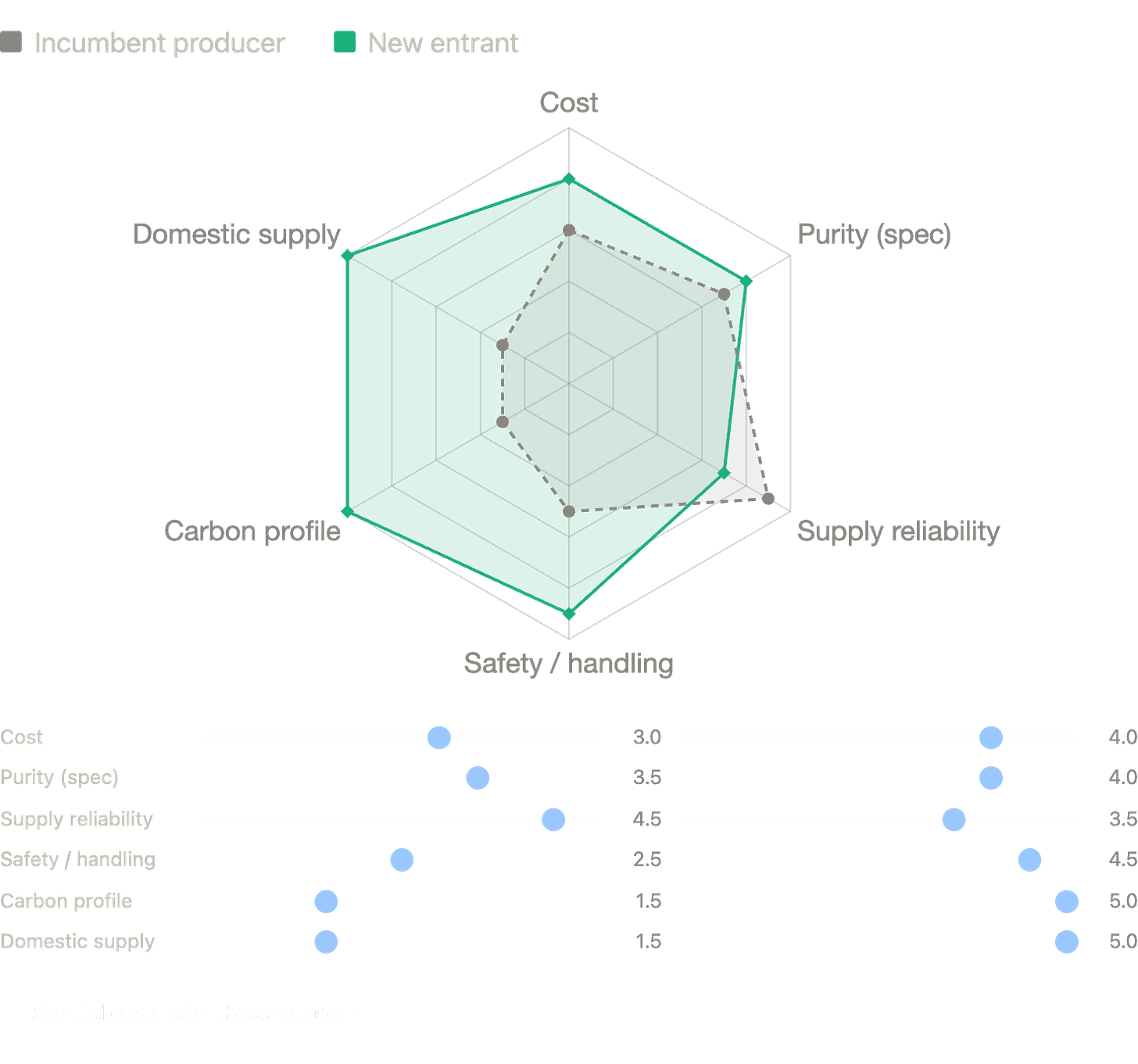
The First Parameter: Cost
In most commodities markets, price is a function of cost, and is the top parameter to consider. In comparison to software, the cost of physical commodities includes the complexity of CapEx vs. OpEx, with CapEx including the complexity of the forms and cost of capital available to the purveyor. Price then layers in supply/demand dynamics on top of an OpEx picture that is usually undifferentiated. Price often settles near the cost of the marginal producer, the highest cost supplier still needed to meet demand. When demand surges, expensive producers get pulled in and prices spike. When demand softens, they get pushed out and prices collapse back onto the cost curve. This is why buying into a high cost producer can provide amazing returns if you time the market cycle right but be ruinous otherwise. A durable cost advantage means never being the marginal producer, which means selling profitably through every part of the cycle.
The Oxymoronic Second Parameter
The second parameter after cost is usually specific to the commodity. How pure are your chemicals? What is the tensile strength of your textiles? How dispatchable is your energy? Customers usually want something oxymoronic from a new commodity provider, an offering indistinguishable from what they already buy but still superlative in some way.
Companies that offer truly new versions of a commodity can succeed, but I’ve categorically avoided them as they’re unlikely to have the same speed to scale and will burn capital while convincing customers to invest the time, energy, and social/political capital to evaluate something new. Classic examples include cultivated meats and edible oil substitutes, where the juice just isn’t worth the squeeze. The better bet is often the same commodity, just better, e.g. more pure chemicals that are made more safely and more reliably.
The Zeitgeist Third Parameter
The whole opportunity to invest in a commodity relies on a finicky third parameter, one that evolves from one “current thing” to another. The zeitgeist parameter if you will.
In the age of climate investing, which I expect to return, this was the carbon emission profile. Non-dilutive funding of R&D and CapEx enabled development of new production methodologies for well understood commodities, often creating a path to unbeatable cost advantages. These subsidies are temporary bridges and must be treated as such. To be investable, a company needs to cross the bridge to a structural cost reduction, unlocking gross margin enhancement. In some cases, the market was (and still is) willing to pay a premium for this third parameter, further enhancing gross margin by increasing price.
In the age of American Dynamism, or sovereignty if we think more globally, the virtue of independent supply chains unlocks similar non-dilutive support on R&D and CapEx with the potential for compressed COGS and expanded price. This is just a different version of the same third parameter, as highlighted by the WSJ in the context of our portfolio company Magrathea.
Looking at these 3 parameters, we have a recipe for a commodity producer that can have its R&D and CapEx funded by non-dilutive capital with premium pricing and a path to lower COGS, which means capturing market share is limited only by production capacity. That last part is counterintuitive to most, i.e. that physical commodities businesses can scale GTM faster than software businesses. Commodity buyers are easy to find, market prices are public, and switching is lower risk by definition, since the product is indistinguishable to the customer. Volumes can be much larger than the $1M enterprise software contract. A software startup has to convince a customer it has a problem, whereas a commodity business just supplies a better version of what the customer is already buying.
What makes these businesses challenging is the obvious: the physical world is much harder to manipulate than the digital world. Physical invention and scaling are much slower and more expensive than digital invention and scaling. So while MOUs and contracted revenue can grow more quickly, recognized revenue often takes more time and capital, making less expensive alternatives to venture all the more important.
Examples from the NV Portfolio
Let’s go back to Solugen. Today, they’re a global company valued at $2B+ with an investor base that includes Founders Fund and Baillie Gifford. Their chemistries provide safer, lower-carbon alternatives for wastewater treatment, agriculture, and industrial manufacturing. Their offerings also include:
corrosion inhibitors for pipelines, naval vessels and aerospace assets
specialty bio‑chemicals used in coatings, lubricants and adhesives
sovereign supplies of precursors for next-generation energetics
The investment in Solugen led to this thesis and several more investments, which I’m excited to share here.
We invested in Magrathea’s first round to support the birth of a clean, domestic supply of magnesium. Magnesium’s uniquely high strength-to-weight ratio makes it a vital input to lightweight vehicles. Tesla, Ford, Toyota, Boeing, Airbus, and many others are using magnesium for lightweighting or exploring how to do so. Magnesium is essential for aluminum alloys, primary steelmaking, and titanium production, and is a federally designated critical mineral. The challenge, and opportunity, is that the vast majority of the world’s magnesium is made in China, and they are increasingly hesitant to export it.
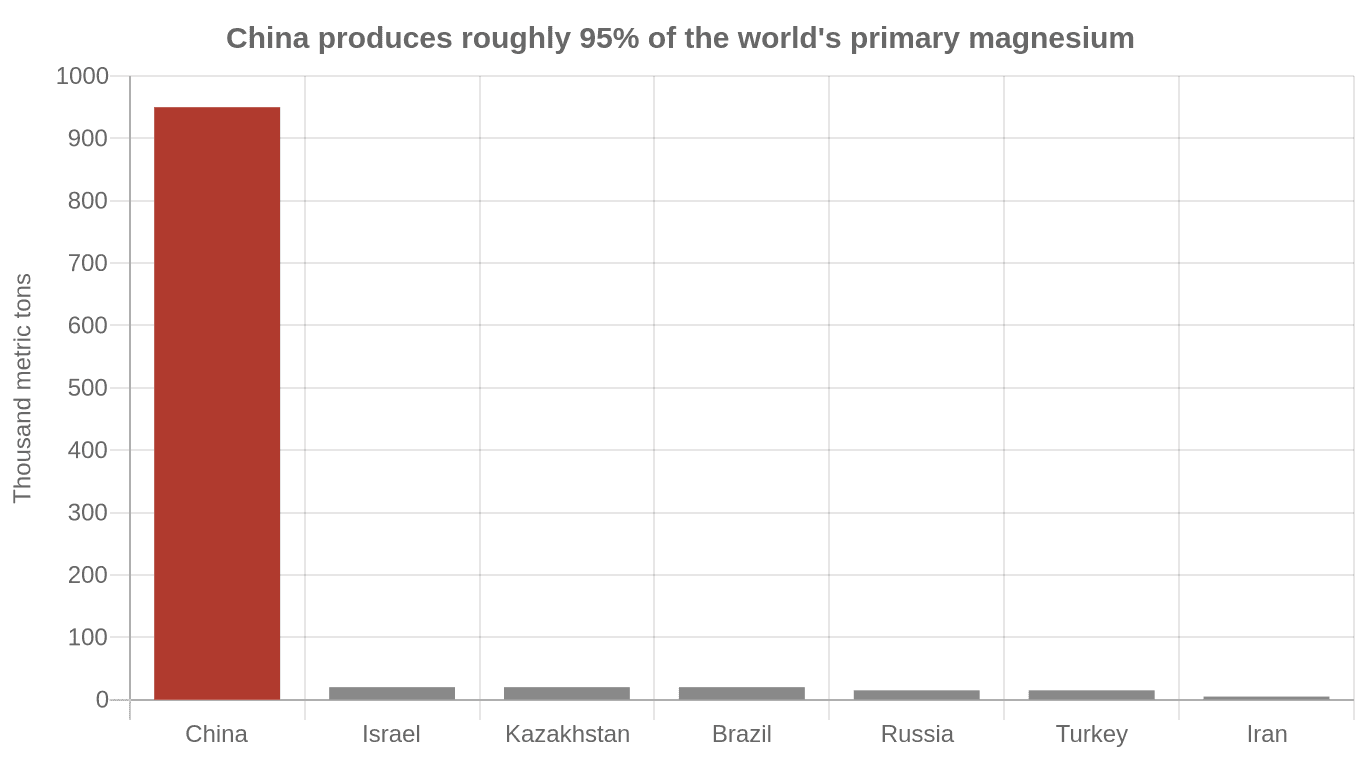
Primary magnesium production by country, 2024. Source: USGS Mineral Commodity Summaries 2025. U.S. production withheld by USGS as proprietary.
China produces magnesium using open-pit quarry mining and coal-fired smelters. Comparatively, Magrathea’s electrolytic process is clean and can flexibly use wastewater, seawater, and other brines as inputs. The rapid progress has brought over $100M to the mission from private investors and government, including Sam Altman, Valor Equity Partners, EQT, Capricorn Group, TETRA Technologies, Inc. (NYSE: TTI), DOE, and DOW. The company’s pilot operation is already actively producing metal that meets DOW specifications and has over $500M per year worth of future metal sales under MOU with multiple binding commercial agreements in place.
Rubi produces cellulosic textiles via enzymatic carbon fixation, mimicking plant cell biology without the overhead of life. They’ve found a wide range of support from industry, including investment from Patagonia, a grant from H&M, and partnerships with brands like Walmart and Ganni.
Circularity Fuels also works with CO2 as one of its inputs, but instead of the organic, enzymatic chemistries that Rubi uses, it operates in the realm of physical chemistry. Their first product is ultra-high-purity methane (UHPM) that is more pure, lower cost, and more reliable than what the market can provide. UHPM is necessary to make synthetic diamonds, both for jewelry and diamond-cooled chips. Circularity also produces jet fuel, which has both climate and sovereignty considerations, bringing them substantial non-dilutive capital alongside $1B+ of demand.
Nevoya is an example of a service commodity, freight, vs. something physical. Nevoya’s story is still somewhat under wraps, but it includes a bevy of Fortune 500 customers and a big win with the Center for Green Market Activation (GMA), which aggregates the buying power of Amazon, Meta, PepsiCo, and a dozen other corporates to deploy zero-emission heavy-duty trucks.
Our 2023 investment in Terra Energy, a verticalized residential solar company, was confusing to some, as the category was stagnant and had a history of cost disease and bankruptcies. But the commodity thesis struck again, this time in the form of extremely low CapEx energy. Since our investment, the company has grown significantly from its Mexico operations. They launched in Florida and became the largest and fastest-growing provider in the state in less than 2 years. More recently, they added a battery offering and launched in Texas.
For years, I would rant to anyone who would listen about how SaaS was the true commodity, and how we were living in a unique moment in time to invest in actual commodities. Whether we’re talking about generating power, producing raw materials, or moving things around, understanding the opportunity in commodities has made us better investors. This understanding is also now relevant to investing in software and intelligence. Intelligence is already exhibiting this pattern, with cost, benchmarking/evals, and sovereignty being three dominant parameters.

