Necessary Nuggets is entering a new era.
Jun 10, 2026
Kaley
In the last edition of Necessary Nuggets, we previewed the upcoming transition of our newsletter from covering the pre-seed and tech markets to sharing original research and thinking from inside the firm.
This is the first “new” edition, now powered by Substack. We hope you like it and welcome any questions, comments, or feedback.
Thanks in advance for sticking with us!
-Neil
The Improbability, Inversion, and Inevitability of Peak Oil
“The Stone Age came to an end not for a lack of stones, and the oil age will end, but not for a lack of oil.”
- Ahmed Zaki Yamani, Former Minister of Petroleum and Mineral Resources of Saudi Arabia
It’s 1956, and M. King Hubbert is preparing to speak at a meeting of the American Petroleum Institute in San Antonio, Texas, when he receives an urgent phone call.
His bosses from Shell Oil Company are begging him not to walk out on stage and predict that U.S. oil production will peak around 1970 before beginning a terminal decline. They’re worried that he will look like Chicken Little and make Shell a laughingstock. Or worse, people will believe him and start to panic.
Hubbert hangs up, decides to completely ignore them, and makes his now-famous proclamation. He goes on to spend the next decade ridiculed by the industry and even attacked by the United States government. But in 1970, right on schedule, U.S. oil production starts to decline, and two OPEC oil shocks add to the fear. The industry revisits Hubbert’s work and “peak oil” rises to the status of a default assumption. It becomes a question of when, not if.
That viewpoint persisted for decades, driving macro trades even into the 2000s. But Hubbert (and many others) failed to fully consider how high prices might drive innovation. Horizontal drilling and fracking unlocked shale oil and a massive boom across the country. Deepwater drilling and oil sands technologies further expanded supply. And the concept of peak oil inverted to one of demand. The International Energy Agency (IEA) now routinely projects that global oil demand will hit its ceiling. This is the new, inverted meaning of “peak oil” - that demand will soon peak, or that it already has.
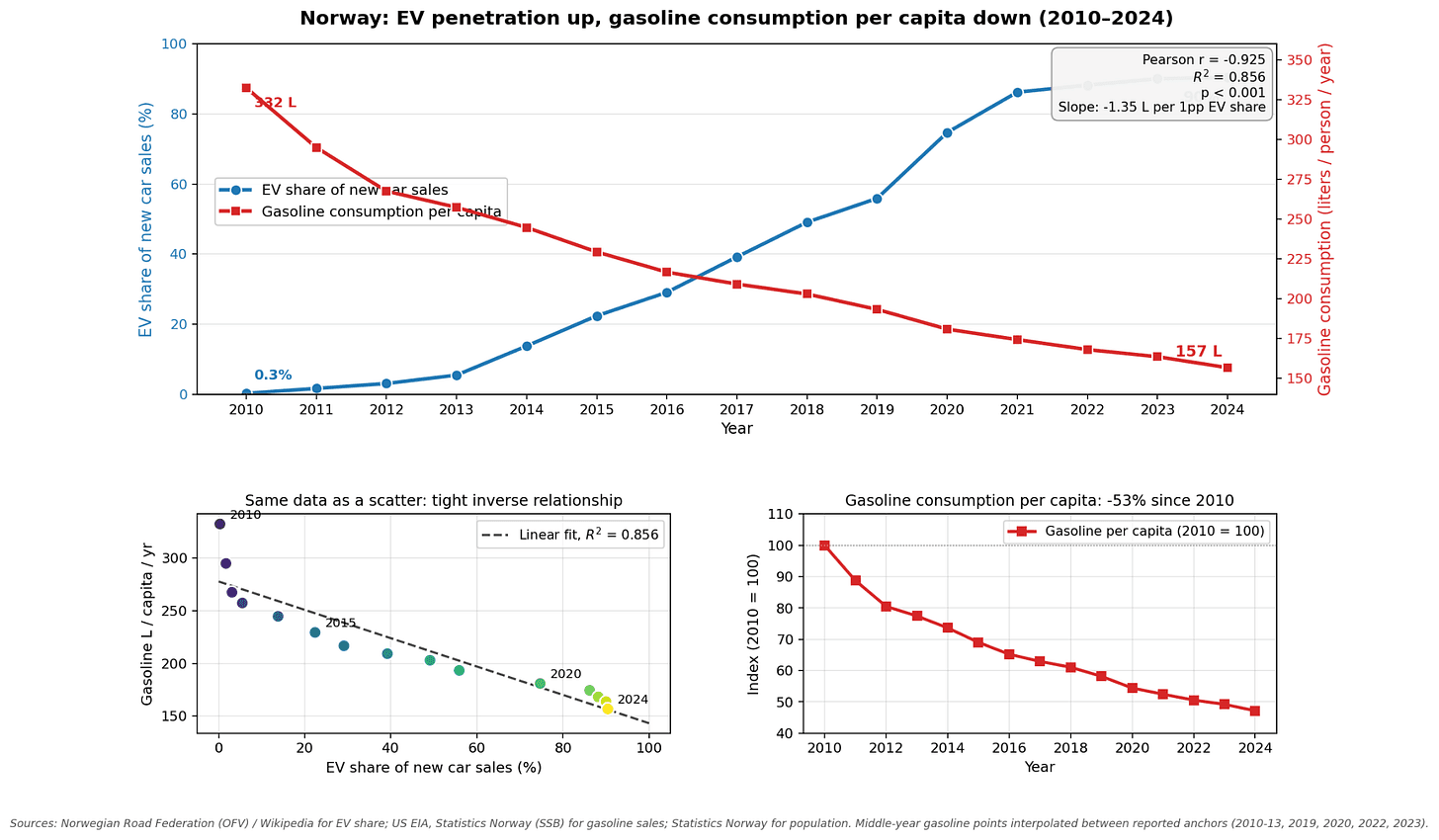
EVs are a new, major contributor here, driving a structural, permanent decline in demand for oil’s primary end product, gasoline. In Norway, for example, EVs make up 97% of new car sales. Since 2010, gasoline consumption per capita is down over 50%.
While the Nordics lead on EV penetration, the fastest growth is in emerging markets, proving that the wealth of a nation isn’t a prerequisite for this transition. EVs are more than half of new car sales in China. In India, Vietnam, and Thailand, share is climbing 50 to 100% a year. EVs are faster, cheaper to operate, and easier to maintain. The shift to EVs has become more market-driven than policy-driven.
The shift has now also become geopolitically driven. EVs come with an embedded hedge against volatile oil prices. Consider the U.S. intervention in Venezuela, the war in Iran, the UAE leaving OPEC. In the current moment, nations across Asia, and their citizens, are receiving a very clear warning of how painful oil-dependency can be. This will only further hasten electrification. As a specific example from a recent, ongoing conflict, Russia’s invasion of Ukraine and volatile oil prices led the EU to mandate a phase-out of new combustion engine vehicles by 2035, targeting a 90% emission reduction supported by EVs, hybrids, and e-fuel vehicles.
EVs, and electrification behind them, are hastening the inversion of “peak oil supply” to the inevitability of peak oil demand.
Because gasoline has been the dominant end product for crude oil, representing about half of the end use in the US, it inherently subsidizes the rest of the petroleum product chain, e.g. aviation fuel, heating oil, and feedstocks for chemicals, plastics, and other synthetic materials that are in nearly everything. A structural reduction in demand for gasoline means reduced economies of scale and a higher cost basis for production of all petroleum products. Demand for end products like aviation fuel, asphalt, and lubricants will not grow fast enough to make up for the shift, forcing a secular rise in production costs and prices.
Dr. Stephen Beaton, CEO of Circularity Fuels, laid it out simply: “For a long time, gasoline was the most valuable product that refineries could create, and aviation fuel was sold as kind of the mid-distillate that people couldn’t get into gasoline. As demand for gasoline falls, aviation fuel prices have to go up to make up for the lost value on gasoline.”
So where are the investment opportunities in a declining-gasoline world?
Most products in the petroleum value chain are very low margin, and customers are uninterested in alternatives. The category with the most innovation potential has been aviation fuels. Thus far, regulation, climate investors, and airlines have driven most of the activity. In the US, the Inflation Reduction Act created massive incentives for sustainable aviation fuels (SAFs), but they were short-lived. The One Big Beautiful Bill kneecapped those incentives and has made longer-horizon investments challenging.
The EU has taken the opposite approach, with hard sticks instead of withering carrots. Penalties for non-compliance are structured to be more expensive than compliance, creating a landscape that makes longer-horizon investments viable. Every update also seems to close a loophole that might prevent SAF adoption, e.g. domicile gamesmanship. We’re currently watching for the adoption of tradability and/or a book-and-claim system for SAFs, akin to the new system in the US for trucking, won by Nevoya, another of our portfolio companies.
I plan to write a post about our commodities thesis in the near future, but as a preview, one of the key aspects is that we love subsidies for CapEx and R&D, but not for unit economics. For us to invest, a company must be able to eventually stand on its own as the lowest producer. And so it is with our investment in Stephen and his team at Circularity.
Circularity’s technologies enable the production of hydrocarbons with high precision and at a low cost. It is the stuff of science fiction, reminiscent of matter compilers from Neal Stephenson’s Diamond Age or the replicator from Star Trek.
Circularity’s first reactor makes ultra-high-purity methane, doing so more affordably and reliably than purified fossil methane and at higher concentrations. This saves large diamond growers millions of dollars and tons of emissions while also growing higher-quality diamonds. The impact of lab-grown diamonds is already being felt in the jewelry market. De Beers is pausing production on a mine in South Africa and planning to shut down a mine in Canada. The rapid rise of demand for lab-grown diamonds is shaping supply, driving prices down even further, well beyond where mined diamonds can compete.
Diamond growers have found a new, second market that is also growing rapidly: computer chips. The tight crystalline structure found in diamonds is unique in the physical world, enabling both high thermal conductivity (using phonons instead of electrons) and high electrical insulation (as the electrons are locked in place). Demand in the jewelry market has driven innovation forward and supply upward enough to unlock the chip market, which will now reinforce a march down the price curve and potentially other new applications.
Since entering the diamond market with the first reactor, Circularity has paired that first reactor with a second reactor, unlocking even more new products. The combination reactor is the most affordable and compact electrified solution for converting methane and carbon dioxide into syngas. Using syngas as an input to the Fischer–Tropsch process unlocks fuel production that is modular and feasible in almost any geography.
There’s much more beneath the surface than I can share here, including what makes this team unique, but with this team, “cheaper jet fuel, made anywhere, without a refinery” was a strong enough thesis for us to invest. Our view is that these fuels will continue to come from hydrocarbons, and that crude oil is not the best input. We also don’t see viable alternatives for powering long-distance flight. No practical energy carrier can match long-chain hydrocarbons on energy density, stability, and ease of handling, even when paired with the efficiency of an electric motor vs. an internal combustion engine. Batteries are just too heavy, and nuclear adds too much risk on top of similar weight issues.
Thinking back to Hubbert, maybe everyone was right to laugh at his peak oil prediction. The innovations in oil exploration and production were foreseeable, at least in an abstract, general sense. Maybe innovations in batteries or other technologies are foreseeable to obviate the need for jet fuels. Maybe the idea of peak oil demand will also end up laughable. After all, petroleum and its end products are so deeply embedded in our lives, and demand continues to grow. But the rate of growth is slowing, the downtrend in gasoline consumption is undeniable, and geopolitical volatility has made energy dependence too costly just as the value proposition of electric vehicles grows stronger each year. This transition seems inevitable, and it will create massive challenges, which will, in turn, create massive opportunities to rebuild our energy and transportation infrastructure. This is why we’re spending time in these areas and investing in disruptive approaches that align with our vision of the future.
If you’re working on these massive opportunities, or interested in learning more about Circularity Fuels, we’d love to hear from you.

